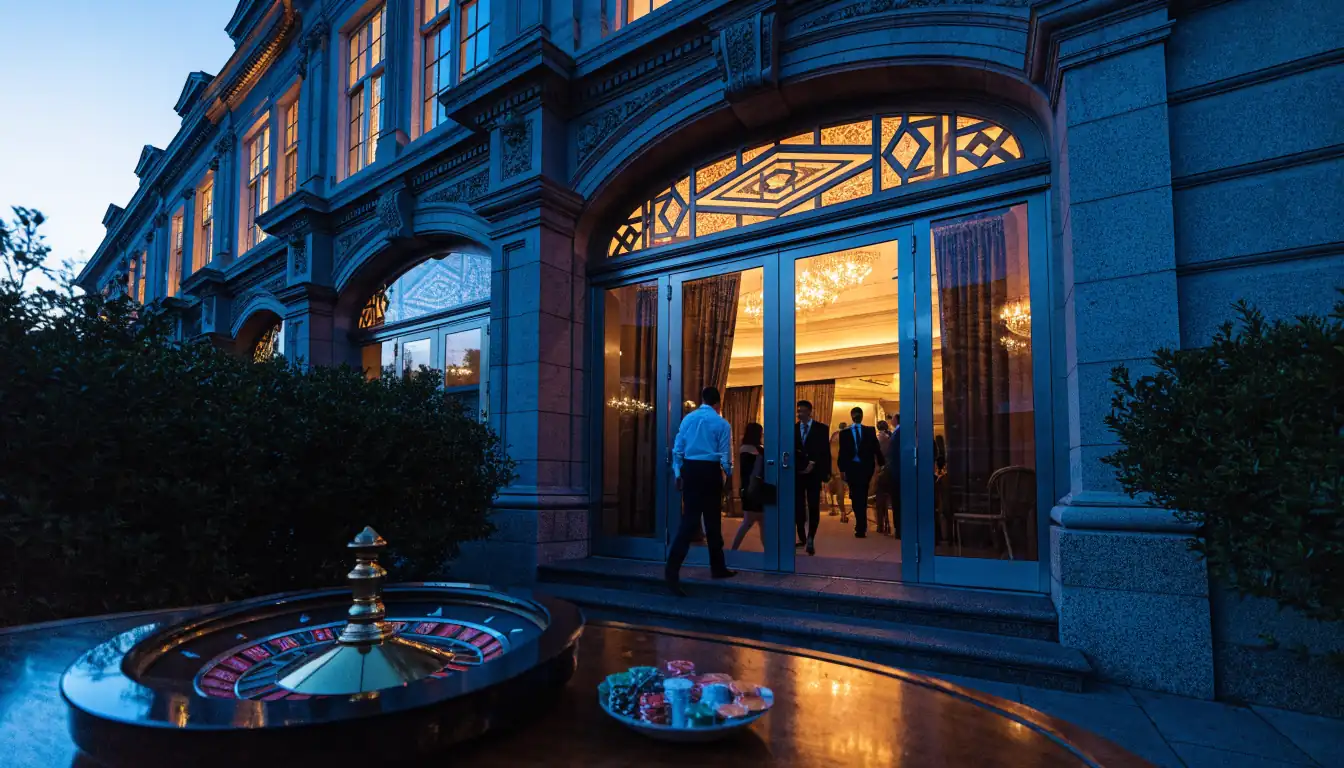
Room offers can vary, so compare the stated services, booking conditions and whether lodging is on the casino property or nearby.
A casino hotel combines an overnight stay with access to a casino venue, but the label alone does not explain what a booking includes. Room-only rates, packages and promotional offers can have different conditions. The useful comparison is therefore between the specific room type, the services included in its price and the rules attached to the offer—not simply between advertised headline rates.
For a stay marketed as a Tasmania casino hotel, the booking information should make clear whether the room is part of the casino property or whether the accommodation is merely nearby. That distinction matters: a casino-branded stay presents lodging as part of the venue experience, while an independent hotel in the surrounding area is a separate accommodation choice. The property name, operator and booking terms help establish which arrangement applies.
A casino hotel room may be sold on its own or as part of a package. A package could bundle accommodation with another service, but the exact inclusions need to be stated in the offer rather than inferred from its title or promotional imagery. If a deal mentions meals, entertainment or casino-related benefits, the terms should identify what is covered, when it can be used and whether any additional conditions apply.
Choosing an online casino while in Tasmania calls for a clear look at each operator’s licensing information and any stated practical details. This list gives a concise reference point for considering the options.
Roby Casino
Roby Casino is listed with a Curacao eGaming license held by Roby Games Ltd.
7Bit Casino
7Bit Casino is operated by Dama N.V. and is listed as licensed in Curacao.
WinSpirit Casino
WinSpirit Casino is listed with a Curacao eGaming license, OGL/2024/923/0383, issued through Antillephone N.V. Its stated minimum deposit is A$30.
SkyCrown
SkyCrown is listed with a Tobique Gaming Commission license. Its stated payout times are around 10–15 minutes for crypto and 1–5 days for fiat, with a minimum deposit of A$30.
JustCasino
JustCasino is listed with a Curacao Gaming Control Board license.
Golden Pokies
Golden Pokies is listed with a Curacao license.
LuckyVibe
LuckyVibe is listed with a Curacao Gaming Control Board license, OGL/2023/176/0095, held by Hollycorn N.V.
Thor Casino
Thor Casino is listed with a Curacao license through Antillephone N.V. (Versus Odds B.V.). Its stated minimum deposit is EUR 20.
DragonSlots Casino
DragonSlots Casino is listed with a Curacao Gaming Authority license held by Jumpman Gaming Ltd.
Vegaz Casino
Vegaz Casino is listed with a Curacao license, OGL/2024/1335/0780. Its stated minimum deposit is EUR 20.
The same care applies to room categories. Descriptions such as “standard”, “premium” or “suite” are not enough to establish the room’s layout or view. The property’s room details should identify the features relevant to the booking, while the rate conditions should clarify payment, cancellation and any restrictions on changing dates. These details are more informative than a broad claim that a rate is a special casino hotel deal.
A comparison is also clearer when like is compared with like. Rates for different room types, booking conditions or package inclusions are not directly equivalent. A lower displayed price may correspond to a more restrictive rate, while a package may include services that are not part of a room-only booking. The written terms provide the basis for assessing the overall offer.
Searches for hotels near a Tasmanian casino can refer to either a casino-operated property or independent lodging in the area. Proximity by itself does not make an independent hotel a casino hotel, and a nearby property should not be treated as casino-operated unless the booking information establishes that relationship.
That distinction also affects expectations. A casino hotel booking does not, by its name alone, establish that a particular service is included, that a room has a specific feature, or that casino access is bundled with the stay. Each claim depends on the terms for the particular property and rate. Promotional language should be read alongside the full description rather than as a substitute for it.
Questions about casino hours can arise during hotel planning, but the room reservation and the casino’s operating schedule are separate matters. A hotel booking does not, by itself, establish when the casino is open. Any stated hours should be confirmed through the venue’s current information, since schedules can be presented separately from accommodation details.
For a casino hotel stay, the clearest basis for comparison is the booking record: the property, room category, rate conditions and itemised inclusions. Those details distinguish an actual hotel offer from a general reference to a casino, and a package from a room-only price. They also prevent the word “deal” from being mistaken for a guarantee of savings or for a particular bundle of services.
A request for poker at a Tasmanian casino can refer to several different things: a staffed poker room, a scheduled tournament, or poker-style play on electronic gaming machines (EGMs). These are not interchangeable. A venue listing that mentions gaming does not, by itself, establish that live poker tables or tournaments are operating. Current venue information is needed to confirm which formats are available.
Tournament details are particularly time-sensitive. A listing should identify whether an event is actually scheduled, how registration works, what game format is played and whether places remain available. Without current confirmation from the venue, claims about a tournament calendar, entry conditions or regular events would be unreliable. A past event announcement is not evidence that the same tournament is still being held.
Gambling Risk
Poker and other gambling activities carry financial risk. Increasing bets to make up losses can deepen them, and a session budget set in advance provides a clearer limit.
The distinction between a poker room and EGMs also matters when checking what a venue offers. Poker played at a table involves a different format from pokies on an EGM, and a general reference to a casino gaming floor does not confirm either a dedicated poker room or a particular table game. Venue descriptions should be read for the specific amenity named rather than treated as a complete inventory of every activity on site.
“Casino rooms” can mean gaming rooms within a venue, private event rooms, or hotel accommodation. In this context, the relevant question is whether the casino has a designated room for poker or another gaming activity. Hotel rooms are a separate subject, and the word “room” alone is not enough to establish that accommodation is included. A gym is another distinct amenity: its presence, access arrangements and operating status need to be confirmed through venue information rather than inferred from the casino label.
Requests about a casino sports bar can likewise refer to a separate venue facility rather than a poker room. A sports bar, if available, is not evidence of poker tables, tournament play or gym access. Keeping those categories separate helps avoid relying on a broad venue description for a facility it does not specifically name.
For questions about whether a venue is open on a particular day, the status of the overall property may not establish that every room or activity is operating. A poker room, tournament, gym or other facility can have its own schedule or access conditions. Current venue notices are therefore more useful than an undated directory entry when the question concerns availability on the day.
The most dependable description is one that states the amenity directly and provides current operating information. If a venue page does not specify live poker, tournament dates or a gym, those details should not be assumed from photographs, general casino wording or references to other facilities. This distinction is especially relevant in Tasmania, where a broad search for casino rooms can produce results covering different services under the same venue name.
Poker and other gambling activities also carry financial risk. Tournament participation or play on EGMs should not be treated as a way to recover losses or meet ordinary expenses. A session budget set in advance provides a clearer limit; increasing bets to make up losses can deepen them. Where poker machines are involved, venues must check identification for gambling, and failing to comply with applicable requirements can have legal consequences.
Parking, bingo and dining are separate parts of a casino visit, and their arrangements should not be treated as interchangeable. Parking searches may refer to general parking, complimentary parking or valet service. Those descriptions do not establish that a particular facility is available at every Tasmanian casino, or that it operates on the same terms across venues. The relevant venue’s current information is the appropriate place to confirm parking access and conditions before travelling.
Bingo is another distinct activity. A search for bingo at a Tasmanian casino does not, by itself, confirm that a venue runs bingo sessions. Session availability and entry arrangements are venue-specific, so they should be checked against current official listings rather than inferred from the casino’s other gaming facilities. The same applies to dining: casino dining may refer to an outlet on site, but it does not establish the type of food service, opening hours or booking arrangements. These details need to be assessed for the particular venue.
The phrase “best casino in Tasmania in 2026” also depends on what is being compared. Parking, bingo and dining can be useful criteria, but they do not support a general ranking without consistent, current information for each venue. A practical comparison separates confirmed services from assumptions: a casino’s gaming status does not prove that it offers a particular parking option, bingo programme or dining service.
Online casino searches require a different distinction: Australian law separates locally provided services from the question of whether an offshore site can be reached. Under the Interactive Gambling Act 2001, operators based in Australia cannot provide real-money online casino games such as pokies, blackjack and roulette to people in Australia. An Australian-run online casino therefore cannot lawfully offer those services to local players.
Some offshore platforms may be accessible, but they are not regulated under Australian law. Their legal position is not equivalent to that of a lawful Australian casino venue, and access does not amount to local authorisation. Offshore operators can also exclude players by blocking internet addresses associated with particular countries. This means a site or game may be unavailable from an Australian connection even if it can be seen elsewhere.
Regional restrictions can also affect individual games. When a game is blocked for Australian access, it may be absent from the lobby shown to a person connecting from an Australian IP address. The absence of a title should not be taken as proof that it has been removed everywhere or that another access method is appropriate. For venue-based activities, current casino information is the relevant reference; for online casino-style gambling, the legal restriction on operators in Australia remains central.
Accommodation near a Tasmanian casino is not necessarily operated by the casino or included in its services. A nearby hotel, motel, apartment or guesthouse may be an independent business, with its own booking conditions, facilities and cancellation rules. The distinction matters when comparing a room advertised as part of a casino stay with a separate property chosen for its location.
A useful comparison starts with the property’s actual address, rather than a label such as “near the casino”. Distance on a map does not establish how straightforward the journey will be on foot or by road. The route, access arrangements and available transport can all affect the practical distance between a place to stay and a venue. Where a listing does not explain these details, its proximity claim should be treated as a description to verify, not a guarantee of convenient access.
The casino’s location is also not a substitute for checking the accommodation’s location. Tasmania-wide searches can return properties in different areas, so a result that mentions a casino may still be unsuitable for a particular visit. Matching the property address to the intended venue helps prevent confusion between similarly described listings and avoids relying on broad regional labels.
Distance on a map does not establish how straightforward a journey will be on foot or by road; the route and available transport affect the practical distance.
A lower advertised rate does not, by itself, show that a stay is better value. The full booking conditions may specify what is included, whether payment is due in advance, and how changes or cancellations are handled. These terms belong to the accommodation provider; they should not be assumed to match any casino promotion. Likewise, a promotion associated with a casino does not establish that a nearby independent property participates in it.
When comparing accommodation deals, the relevant details are the total price shown at booking, the dates covered, the room conditions and any extra charges stated by the provider. If an offer is presented as linked to a casino visit, the relationship should be made clear in the booking information. An unclear reference to a casino promotion is not evidence that a room, transport or other service is included.
Reviews and listing descriptions can help identify questions about access, noise or the property’s facilities, but they do not replace current booking details. Information may differ between third-party listings and the accommodation provider’s own terms. For a decision involving a specific date or rate, the provider’s current information is the more relevant basis for comparison.
The nearest property may not be the most suitable one. A slightly more distant stay could better match a visitor’s transport arrangements or preferred facilities, while a property close to a venue may still require a route that is inconvenient for that visitor. These are matters to assess for the individual booking; no general claim about nearby access applies to every Tasmanian casino or accommodation listing.
Parking should be checked with the accommodation provider if a vehicle is part of the plan. A casino’s location does not establish that a nearby property offers parking, nor does it confirm that parking is included in the room rate. Similarly, venue opening times do not determine a property’s check-in or reception hours. Those arrangements should be confirmed separately.
The most reliable comparison therefore keeps three questions distinct: where the accommodation is, what the provider actually includes, and how the journey to the casino would work. This avoids treating proximity as an affiliation and prevents an advertised deal from being mistaken for a casino-operated stay.
A reliable contact route begins with identifying the specific Tasmanian venue. Searches for a casino’s phone number or address can return map listings, older directory entries and third-party pages alongside official information. The venue’s own website is the strongest starting point for current contact details; a listing on a map service can help locate the site, but should not be treated as the final authority if its details conflict with the venue’s information.
A map is useful for checking the location in relation to nearby roads and landmarks. Before setting out, compare the mapped destination with the address published by the venue, particularly where a listing uses a shortened name or a general site pin. This can reduce the chance of navigating to an entrance or building that is not the intended destination. Map directions indicate a route, not necessarily the venue’s current access arrangements.
Contact details are also useful when an event or facility has its own conditions. A general enquiry can establish whether a listed performance is going ahead and where the event information is maintained. For a bar, direct confirmation is relevant to current opening hours, entry conditions and any event-related changes. Such details can change, so a cached search result or an undated directory entry is less dependable than information published by the venue close to the intended visit.
Concert listings should be checked for the date, venue space, ticketing arrangements and any changes to the programme. A casino-branded event listing does not by itself establish that a performance is still scheduled or that tickets remain available. Where a ticketing page and venue page differ, the latest direct notice from the venue or ticket provider is the more useful reference point. Event information should also be distinguished from general casino opening information: a scheduled concert does not establish that every facility is open at the same time.
Queries about baccarat or craps require the same care. A search result containing a game name does not confirm that the game is offered at a particular venue, or that it is available on a particular date. The venue’s current gaming information or a direct enquiry is needed to establish availability and any applicable entry or participation conditions. These terms refer to in-person venue games here; they should not be taken as an invitation to use online casino services. Under the Interactive Gambling Act 2001, operators cannot provide real-money online casino games to people in Australia.
For practical enquiries, details should be checked against the relevant venue rather than assumed to apply across Tasmania. A phone number, address, bar listing, concert page or game reference can all become outdated independently. Confirming the specific detail through an official venue channel is therefore more dependable than relying on a broad directory result, especially when travel or event attendance depends on it.
Breakfast and buffet searches can refer to different things: a meal served at a casino venue, a resort package, or a buffet that operates only at particular times. The phrase “casino breakfast in Tasmania” does not, by itself, establish that a casino has a breakfast service or that it is included with a stay. Current menus, service hours and booking conditions need to be confirmed through the venue’s own information before making plans. The same distinction applies to buffet breakfasts: an older listing or a general resort description may not reflect the service currently available.
The term “casino resort” can also combine several separate expectations, including accommodation, food service and gaming facilities. Those features should not be assumed to be bundled. A food listing may relate to a separately operated outlet, while resort wording may describe a broader property rather than a particular breakfast offer. Where details are not published by the venue, there is not enough evidence to state that a buffet is operating, what it costs, or whether it is available to non-guests.
People looking for casino jobs in Tasmania may be referring to positions at a casino property, a hotel or an associated food-service business. These are not necessarily the same employer. A vacancy should be assessed by its named employer and the duties listed, rather than inferred from a broad description of a casino resort. Job advertisements provide the relevant evidence on role requirements, location and application process; a general search result does not establish that a particular position is open.
Attention Online free-spin promotions are not equivalent to in-person venue rewards and are subject to various wagering requirements before winnings can be withdrawn.
Similarly, a search for casino rewards may refer to a venue’s customer programme or to online promotional offers. The wording alone does not confirm that a Tasmanian venue has a rewards programme, or specify its benefits or eligibility rules. Any programme details should be attributed to the venue that operates it. Online bonuses are a separate matter and should not be treated as part of a local venue’s hospitality offering.
Australian law prohibits operators from providing real-money online casino games, including pokies, to people located in Australia. As a result, online free-spin promotions are not equivalent to in-person venue rewards, and this information is not an invitation to use them. Promotional terms can impose conditions before winnings are withdrawable. A report published by psu.com described free-spin wagering requirements in the range of 20 to 50 times; that figure is a reported example, not a universal or current rule. The report also described pokies as contributing fully toward wagering requirements. Separately, a specialist review stated that free-spin winnings had to be wagered 30 times before withdrawal. These accounts illustrate why promotional conditions cannot be assumed to be consistent across offers.
For a Tasmanian breakfast, buffet or employment decision, the relevant evidence is the current information from the venue or the named employer. Online reward language should be kept distinct from those local services and read in light of the Australian legal restrictions.
Whether a Tasmanian casino is open is a time-sensitive question, and a past listing or review may not describe its present status. “Open” can refer to a venue operating normally, while a temporary closure may affect only part of its facilities. A reopening announcement is different from confirmation that the venue has resumed ordinary operations. These distinctions matter when assessing claims about a casino reopening or a proposed change to its operations.
For a current status check, the most useful evidence is a recent notice issued by the venue or an official public update. A dated announcement should be read in context: it may concern a particular facility, event or period rather than the casino as a whole. Older travel pages and user reviews can help explain what a venue offered at an earlier date, but they are not reliable confirmation of present opening arrangements.
Casino development can refer to several different stages: a concept, a planning proposal, an approved project or construction. These are not interchangeable. A proposal does not establish that work has begun, and a planning decision does not by itself confirm when a project will be completed or what its final facilities will include. A review of development claims is strongest when it identifies the stage being described and relies on dated public notices rather than promotional language alone.
Employment information also needs to be read according to its purpose and date. A vacancy notice describes a role being recruited for at the time it was published; it does not establish the venue’s overall staffing needs or guarantee that the position remains available. Similarly, statements about jobs connected with a development should be distinguished from confirmed vacancies. Employment searches are best assessed through current recruitment information and the stated status of any project involved.
Entertainment may refer to scheduled performances, special events or other activities offered at a venue. An event listing is evidence of a particular programme, not necessarily a regular schedule. Dates, venue status and any conditions attached to attendance should therefore be checked against the organiser’s latest announcement. This keeps a past event page from being mistaken for a current calendar.
A casino review can provide useful observations about atmosphere, facilities and entertainment, but its date and scope matter. A review focused on one visit cannot establish that the same programme or operating arrangements continue. Likewise, a menu reproduced in an older review is not dependable evidence of current food service; restaurant details are best checked separately against current venue information.
Taken together, status, development and entertainment claims call for different kinds of evidence. Current operating notices address whether a venue is open; dated planning information clarifies the stage of a development; and current event listings establish what is scheduled. Keeping these categories separate makes a Tasmanian casino review more informative without treating proposals, past experiences or isolated events as proof of present conditions.
Restaurant information is a separate consideration from casino gaming. A restaurant may be within a casino complex without being part of the gaming floor, and its menu, service style and operating arrangements should be assessed on their own terms. The phrase “Tasmanian casino restaurant” can refer to very different dining experiences, so the venue name alone does not establish what is served or how the restaurant operates.
A useful comparison starts with the restaurant’s own current information. Menus indicate the type of cuisine, the range of dishes and whether prices are published; they can also show whether dietary requirements are addressed. Where details are unclear, the restaurant’s official listing is more reliable than an undated directory entry or an old review. Menus and service arrangements can change, so older descriptions should not be treated as confirmation of present offerings.
The dining format also matters. A sit-down restaurant is not interchangeable with a casual food counter, a buffet or a bar serving meals. These distinctions affect the setting and the kind of service expected, even when the facilities share a building. Restaurant-focused searches are best answered by checking the specific outlet rather than assuming that every food option at a casino is a restaurant.
Reviews can help describe atmosphere and service, but they are individual accounts rather than guarantees of a consistent experience. A more informative review identifies the outlet and gives concrete observations about the meal or service. Broad praise or criticism, without those details, offers less basis for comparison. Recent reviews may be more relevant than older ones, while a restaurant’s own published menu is the stronger reference for what it currently lists.
For visitors comparing casino restaurants in Tasmania, practical details include whether advance booking is offered, the stated service hours, menu availability and any conditions attached to entry or dining. These details should be confirmed through the restaurant or venue’s current information before a visit, rather than inferred from the casino’s general opening status. A casino venue’s location does not itself confirm that a particular restaurant is open at a given time.
The term “best” is therefore dependent on the criteria being used. One diner may prioritise cuisine and menu range; another may value service, atmosphere or suitability for a particular occasion. Without comparable, current evidence across restaurants, a definitive ranking would overstate what can be concluded. A grounded choice rests on the details each restaurant publishes and on specific, recent accounts of the dining experience, not on the casino name alone.
A request for a Tasmanian casino address is best treated as a venue-identification task, not simply a search for a city name. Tasmania has casino venues in different locations, so the exact property matters when checking directions, arranging transport or confirming an appointment. Maps can be useful for route planning, but the venue’s own listing is the more appropriate reference for its current street address and entry point. A map pin may indicate the broader property rather than the entrance intended for visitors.
Spa-related searches call for a similar distinction. A casino day spa may be operated within a larger resort, separately managed on the same property, or located nearby without being part of the casino. Those arrangements affect where bookings are made and which facilities are included. The terms “casino spa” and “spa near a casino” therefore should not be treated as interchangeable. Before making plans, the relevant provider and the specific location should be identified.
Career searches also benefit from separating the employer from the workplace. Roles associated with a casino property may sit in gaming operations, accommodation, food service, maintenance or administration, and not every position necessarily belongs to the casino operator. A vacancy listing should identify the employing organisation, work location, duties and application process. General career pages can describe an employer, while individual advertisements establish whether a role is currently available.
Dress expectations are another point where assumptions can mislead. Requirements may differ between gaming areas, restaurants, events and other parts of a property, and can change with the occasion. A general description of a venue’s atmosphere does not establish a formal dress policy. Where entry requirements matter, the specific area and event should be checked against current venue information rather than inferred from photographs or older visitor accounts.
These details are practical, but they are not interchangeable. An address identifies the property; a spa listing identifies a service provider; a careers page identifies an employer; and a dress policy applies to a particular setting. Keeping those distinctions clear makes it easier to evaluate whether a listing answers the actual question, without assuming that every amenity, job or rule is part of the casino itself.
Food options and pool access are separate practical considerations when comparing casino venues in Tasmania. A general food listing may cover several kinds of service, while “food court” describes a shared area with multiple food outlets rather than a single sit-down restaurant. The label alone does not establish which outlets are operating, their menus, service hours or whether they are inside the casino complex.
For a useful comparison, venue information should make clear whether food is available on site, where the outlets are located and whether access is restricted to guests or visitors. These details can affect whether a venue suits a quick meal between activities or a longer visit. Outlet names and opening information should be checked against the venue’s own current material, since services and operating arrangements can change.
Pool facilities require a similar distinction. A pool associated with a casino search may belong to a hotel or leisure facility rather than form part of the gaming area. A listing should identify the facility’s location and any access conditions, rather than relying on the word “pool” alone. It should also clarify whether the pool is available to day visitors or only to certain guests, where that information is published.
Food outlets and pools should not be treated as guaranteed features of every casino venue in Tasmania. Their presence, access arrangements and current availability are venue-specific. Official venue information is the appropriate basis for confirming these practical details before making plans. This keeps the comparison focused on facilities that are actually relevant to a visit, without confusing a nearby service with an amenity operated by the casino.
Offshore casinos are not regulated under Australian law, and it is technically not illegal for Australian players to use them; Australian-run online casinos cannot offer online casino games to players in Australia. In NSW, players must be 18 or older to use poker machines, and mandatory pre-commitment systems require players to set a loss limit before playing.
Check the pokie’s RTP and whether it has features such as a progressive jackpot or a bonus-buy option. Also review the wagering conditions attached to free-spin winnings before making a deposit.
Online pokies use a Random Number Generator (RNG), so each spin is independent and previous results do not affect the next one. RTP describes the theoretical share of wagers paid back over a very large number of spins.