The phrase can describe a casino setting or appear in online gambling material, but it does not establish a venue category or licence.
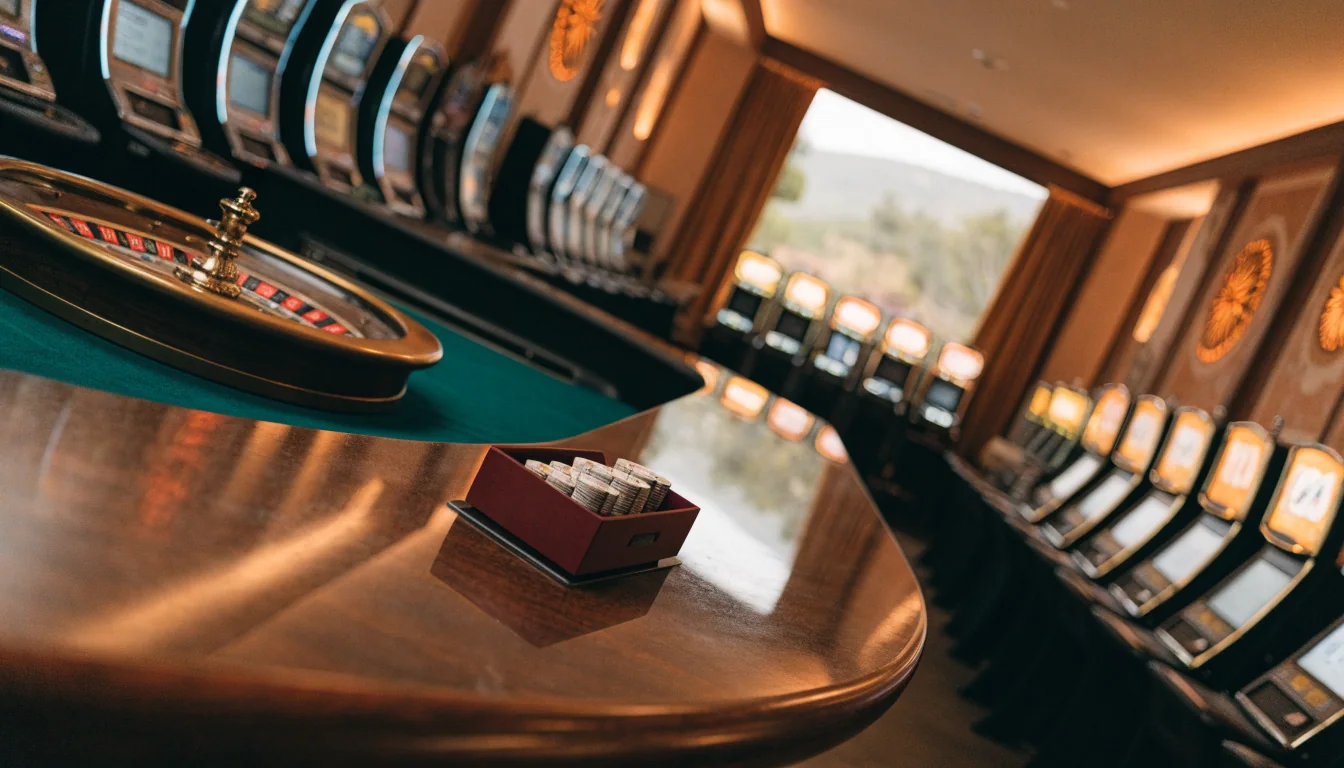
In Australia, “pokies” is a familiar informal term for gaming machines. “Parlour” may suggest a dedicated room or a particular kind of venue, but the phrase does not, by itself, identify a defined national category of casino. Its meaning depends on context: it may refer loosely to a land-based casino setting, or it may be used in material about online gambling. Those are distinct contexts and should not be treated as interchangeable.
The established casino sector is made up of physical properties operating under jurisdictional oversight. Australia’s casino industry is regulated by state and territory governments, and each property operates under a licence issued by the jurisdiction in which it is located. Consequently, the word “casino” does not point to one national licensing authority or a single uniform venue framework. The relevant local jurisdiction is part of what defines a land-based casino’s regulatory setting.
This distinction matters because “pokies parlour” is descriptive wording, not proof of a venue’s status. A phrase that sounds like a place name or a category does not establish that a particular business is a casino, that it holds a casino licence, or that it operates under the same rules as a casino elsewhere in Australia. The jurisdiction-specific nature of licensing means that claims about a property need to be understood in relation to its location and local authorisation, rather than inferred from a label.
Choosing a pokies parlour casino in Australia calls for a look at the details that can be verified, especially licensing and any stated payment information. Use these notes as a concise reference when reviewing the options.
Roby Casino
Roby Casino is listed with a Curacao eGaming license held by Roby Games Ltd.
7Bit Casino
7Bit Casino is operated by Dama N.V. and is listed as licensed in Curacao.
WinSpirit Casino
WinSpirit Casino is listed under Curacao eGaming license OGL/2024/923/0383, issued through Antillephone N.V. Its stated minimum deposit is A$30.
SkyCrown
SkyCrown is licensed by the Tobique Gaming Commission. Its stated payout times are around 10–15 minutes for crypto and 1–5 days for fiat, with a minimum deposit of A$30.
JustCasino
JustCasino is listed with a Curacao Gaming Control Board license.
Golden Pokies
Golden Pokies is listed as licensed in Curacao.
LuckyVibe
LuckyVibe is listed with Curacao Gaming Control Board license OGL/2023/176/0095, held by Hollycorn N.V.
Thor Casino
Thor Casino is listed with a Curacao license through Antillephone N.V., with Versus Odds B.V. as operator. Its stated minimum deposit is EUR 20.
DragonSlots Casino
DragonSlots Casino is listed with a Curacao Gaming Authority license, with Jumpman Gaming Ltd named in connection with the license.
Vegaz Casino
Vegaz Casino is listed with Curacao license OGL/2024/1335/0780. Its stated minimum deposit is EUR 20.
The phrase can also be confusing because it combines a term associated with gaming machines and one associated with a room or venue. In ordinary use, that combination may describe a physical setting in broad terms. It may also appear in online material that uses venue-like language for a website. The wording alone cannot settle which meaning is intended. The legal distinction is clearer: Australian casino venues are physical properties licensed by their local jurisdictions, while the Interactive Gambling Act 2001 prohibits operators from providing real-money online casino games to people physically in Australia. Casino-style games delivered online are therefore not simply another form of a land-based parlour.
That legal distinction does not depend on whether online material adopts the language of a venue. Calling a website a parlour, casino, or gaming room does not turn it into a licensed Australian casino property. Conversely, a physical casino’s use of gaming machines does not make it an online service. The relevant questions differ: for a venue, location and the applicable local licence define the regulatory context; for an online casino-style service, the federal prohibition on providing such games to customers in Australia applies.
The scale of the physical sector can be described only with care. A specialist review has reported more than 20 full-scale casinos across Australia’s eight states. That is a time-sensitive count reported by a secondary source, not a fixed definition of “pokies parlour” or a permanent description of the market. Counts may depend on what the source classifies as a full-scale casino and can change as properties or classifications change. The number should therefore not be read as evidence that every venue using parlour language belongs to that category.
Operating hours and entry age offer more concrete context for major casino venues. All major Australian casinos operate around the clock, and the minimum age for casino entry is 18 nationwide. These details concern access to physical casinos; they do not establish that every venue using similar language is a casino, nor do they describe the terms of access to an online service.
Accordingly, “pokies parlour” is best understood as an imprecise expression rather than a regulatory classification. In a land-based context, it may point broadly to casino gaming-machine facilities, but the property’s location and local licensing determine its status. In an online context, venue-like wording does not alter the legal position under federal law. Keeping those meanings separate prevents a familiar phrase from being mistaken for evidence of a particular kind of casino or authorisation.
Major Australian casinos operate 24/7, and the minimum entry age is 18 nationwide.
A site that loads in Australia, accepts account traffic or appears under a new web address has not thereby demonstrated that it is authorised to provide online casino games here. Technical availability and legal status are separate matters. A working page may show that a domain can be reached at a particular time; it does not establish that the service may lawfully offer casino-style gambling to people in Australia.
The governing federal framework is the Interactive Gambling Act 2001. It prohibits operators from providing real-money online casino games to customers physically located in Australia. The prohibition covers casino-style services such as slots, poker, blackjack and roulette. An overseas address, a functioning registration page or a claimed foreign authorisation does not alter that rule. The legal question concerns the service being provided to Australians, not simply where a company or its website is based.
The Australian Communications and Media Authority (ACMA) is the federal regulator responsible for enforcing the Act and monitoring compliance with federal interactive gambling laws. Its role includes action against prohibited services and advertising. ACMA can ask Australian internet service providers to block access to websites that provide prohibited interactive gambling services or advertise them in Australia. Blocking is an enforcement measure, rather than a certification system: a site that remains reachable has not received approval by virtue of being accessible.
This distinction also explains why alternate domains can be misleading. Website blocking may affect whether a particular address resolves through an Australian internet provider, while replacement addresses may appear over time. A change in domain can therefore affect access without changing the nature or legal status of the underlying service. Nor does an address that continues to work prove that a site has escaped regulatory attention or holds an Australian online casino licence.
ACMA reports substantial enforcement activity. Following enforcement actions, it has blocked more than 1,455 illegal gambling and affiliate websites since November 2019.
For searches about playing casino games online, the central distinction is therefore between being able to open a website and the service being lawful in Australia. Neither account access nor a substitute domain establishes local authorisation. Under the federal framework, real-money online casino games remain prohibited when provided to people in Australia; enforcement may include requests to block the relevant websites. ACMA’s published actions concern services and their promotion, rather than turning a site’s momentary accessibility into evidence of permission.
The phrase “free play” does not itself settle the legal character of an online service. Where a site offers real-money casino gambling to people in Australia, the relevant issue is the service being provided, not the wording used to describe it. Website appearance, domain changes and promotional labels are not substitutes for the legal framework. This section concerns online services; land-based casino venues operate under a separate, jurisdiction-specific system.
Claims of a no-deposit bonus or a reward for opening an account describe a promotional offer, not evidence that an online casino is authorised to serve people in Australia. The wording may appear on a page, in an advertisement or beside a changing web address, but none of those appearances establishes that the underlying service is lawful here. Nor does a promotional claim establish that the offer is genuine, available or capable of being used on the terms implied.
Legal Prohibition
Under the Interactive Gambling Act 2001, providing real-money online casino games to people physically located in Australia is prohibited.
The legal distinction is material. Under the Interactive Gambling Act 2001, operators may not provide real-money online casino games to people physically located in Australia. Casino-style services, including slots, poker and table games, fall within the prohibited category. Advertising such services to Australian audiences is also prohibited. A sign-up reward or a no-deposit offer cannot change the legal status of the service it promotes; describing an inducement does not create an exception to the prohibition.
Accordingly, promotional language should not be treated as a recommendation or as a practical route to online casino play in Australia. A page may use terms such as “free,” “welcome” or “no deposit,” but those labels alone do not establish what is offered, who is eligible, whether the offer can be redeemed, or whether the service may lawfully be provided to Australians. Without reliable, independent evidence, the claim remains an assertion made in promotional material.
Domain names add a separate source of uncertainty. A specialist review reports that access restrictions can alter which web addresses are reachable through Australian internet providers, while alternative addresses may emerge later. That observation concerns changing access routes; it does not verify an offer, identify the operator responsible for a page, or demonstrate that a service is licensed for Australian users. A familiar brand name or a newly appearing address is not proof that a promotion is legitimate.
The same caution applies when a promotional page appears to contain detailed conditions. Specificity can make a claim look authoritative, but it does not independently confirm that the stated terms are current or enforceable. Nor does a page’s continued appearance establish regulatory approval. In Australia, the relevant legal question is not whether the offer sounds plausible or whether a website can be reached, but whether the operator is permitted to provide the advertised online casino service to people in the country. For real-money casino games, the federal prohibition is the controlling context.
A claim can therefore be assessed only within limits. The wording may show that a page is presenting an inducement; it cannot, by itself, prove the operator’s identity, the accuracy of the advertised conditions or the legality of the service. A change of domain does not resolve those uncertainties. Equally, the presence of a promotional page should not be taken as confirmation that an offer is available to Australian residents.
This distinction prevents promotional language from being mistaken for regulatory evidence. No-deposit and account-opening claims are not evidence of lawful access, and an alternate web address does not make a prohibited service permissible. In Australia, online casino inducements cannot be treated as ordinary consumer offers detached from the service they promote: the underlying real-money casino activity is prohibited, and advertising it to Australian audiences is prohibited as well.
References to complimentary chips, spins or play can make an online page appear connected to a physical Australian casino. The wording alone does not establish that connection. “Chips” and “spins” describe different forms of casino-style play, while “free” signals a promotional claim. None of those terms identifies a licensed Australian venue or confirms that a page represents one.
A domain name is similarly limited evidence. An online service may appear under more than one address, and website blocking can affect which addresses resolve through Australian internet service providers. An alternate address may therefore appear after another one becomes inaccessible. A change in address is a technical or operational development; by itself, it does not establish a change in ownership, authorisation or relationship to a land-based casino.
The Australian Communications and Media Authority (ACMA) has taken website-blocking action against illegal gambling services, including alternate domains associated with Fair Go. A specialist review reports this enforcement history, but the appearance of an alternate domain should not be read as proof that a service has been approved or restored. Nor does an address that loads establish that it is authorised to provide online casino games in Australia.
This distinction matters when a page uses familiar venue language alongside claims about free chips or spins. A reference to a “parlour” may evoke an in-person gaming area, while an online page may use the same language as branding. The words can describe the page’s presentation, but they do not verify a physical location, a venue operator or a relationship with an Australian casino.
Promotional language is also not independent evidence of what a service provides. A claim of free play may be displayed in a headline, image or sign-up prompt, but its presence only establishes that the page makes the claim. It does not establish that the offer is available, that a physical casino is involved, or that the website’s domain has a particular regulatory status. Those are separate questions and require evidence beyond the promotional wording.
Domain changes can further complicate identification. A familiar name appearing at a different address may be presented as a continuation of a service, but resemblance in names or design does not prove continuity. Conversely, an address that differs from one previously encountered does not, on its own, show that the underlying service has changed. ACMA’s blocking actions provide relevant context: access may be disrupted, and alternate domains may appear, without that sequence demonstrating legal approval.
Accordingly, claims about free chips or spins should be kept distinct from evidence about Australian casino venues. Promotional terms describe what a page says; domain behaviour describes how an address is reached or changes. Neither, on its own, verifies that an online page is an Australian casino or that it has a recognised connection to a land-based one.
Attention: The appearance of alternate domains or a functioning website does not establish that an online casino service is authorized to operate in Australia.
A review of a supposed “pokies parlour” is useful only to the extent that its claims can be tied to an identifiable venue, operator and regulatory setting. The phrase may be used loosely in promotional material, so its presence in a heading does not establish that a casino property exists under that name or that the reviewer has assessed a specific place. A credible account should make clear what is being reviewed and distinguish observation from interpretation.
The first question is whether the review names a physical venue or describes an online service using parlour language. Those are not interchangeable subjects. A review that moves between them without saying so may leave unclear whether its statements concern entry, facilities and on-site operations, or a website and its terms. The distinction matters because evidence about one cannot establish the qualities or status of the other.
Claims about a venue should be specific enough to be checked. Statements about its location, access arrangements or facilities are stronger when they identify the property and explain the basis for the description. A review that offers only broad praise or criticism, without indicating what was observed or how the information was obtained, provides little basis for an independent assessment. The same caution applies to photographs and quoted comments: they may illustrate a claim, but do not by themselves establish its accuracy or currency.
Australian casino regulation is administered at state and territory level. Each casino property operates under a licence issued by the jurisdiction in which it is located. Accordingly, a review that refers simply to an “Australian licence” without identifying the relevant jurisdiction and property has not supplied enough detail to establish the licensing position.
This does not mean that every review must reproduce regulatory documents. It does mean that licensing statements should be precise and attributable, rather than presented as a general assurance. The regulator responsible for the relevant jurisdiction is the appropriate point of reference for a property’s licensing status. A reviewer’s description of a venue as “licensed” is not a substitute for identifying which authority issued the licence.
Tone is not proof of bias, but the structure of a review can reveal what it is designed to do. An account that gives concrete observations, explains limitations and distinguishes confirmed details from opinion is more informative than one made up of unqualified claims. If the text directs attention to a particular service, uses repeated praise, or presents assertions without explaining their basis, its promotional purpose should be considered when weighing its conclusions.
Dates also matter. Reviews can remain online after the circumstances they describe have changed. A publication date, update history and clear indication of which claims were checked help establish the period to which the assessment applies. Without that context, a once-accurate description may be mistaken for a current one.
A reliable pokies parlour review is therefore not defined by its rating or confident wording. Its value rests on whether the subject is unambiguous, the claims are traceable, and any licensing statement reflects the jurisdiction responsible for the named property. Where those elements are absent, the review may record an opinion, but it cannot establish the underlying facts.
Casino searches in Australia can refer to venues separated by long distances and operating within different state or territory systems. Each property holds a licence issued by its own jurisdiction, so a name or address is best understood in its local setting rather than as evidence of a single national venue network.
The Northern Territory illustrates how a regional count can describe a particular directory’s coverage rather than a permanent market total. A specialist casino review lists three casinos across three Territory cities. In that same account, Alice Springs has the highest city-level count in the Territory, at one casino. These figures should be read as that review’s snapshot, not as timeless totals: venue listings can change, and counts depend on what a source includes as a casino.
One identifiable Alice Springs property is Lasseters Casino. Its street address is 93 Barrett Drive, Alice Springs, NT 0870, Australia. Naming the suburb-free street address and postcode distinguishes the venue’s physical location from broader references to the town or the Territory. It also shows why location details matter when several places share a state or territory label.
Queensland provides a coastal example. Jupiters Gold Coast Casino & Hotel occupies Broadbeach Island on the Gold Coast. The island setting is a more specific geographical description than the city name alone, while the Gold Coast label places the venue within Queensland. These distinctions are useful when comparing listings that may refer to a city, a suburb, an island or a street address as though each were the same level of location information.
Tasmania offers a different regional reference: Country Club Casino is listed on Country Club Avenue in Prospect, within Meander Valley. That description connects the venue to a locality and a municipal area rather than relying only on the island state’s name. Across the examples, addresses vary in precision, but each identifies a physical place rather than an online destination.
These locations should not be treated as interchangeable examples of one uniform venue type. The Territory count is a source-specific regional snapshot; the named properties in Alice Springs, Broadbeach Island and Prospect are location references. Their differing formats—street address, island and locality—reflect how casino listings identify places at different geographic scales. The relevant licence remains tied to the jurisdiction in which each property operates.
For a land-based casino search, the geographic chain is therefore significant: a state or territory narrows the region, a city or locality narrows it further, and a street address can identify a specific site. In this context, Australian casino locations are not merely labels attached to a national category. They point to particular places, each situated within its own regional and regulatory setting.
A request for a bonus associated with a pokies parlour can return pages describing promotions, account offers or supposed rewards. The presence of that language establishes only that a page makes a claim. It does not show that an offer is genuine, available to people in Australia, or lawful to provide.
Repetition of a promotional claim across multiple pages does not constitute independent verification of its accuracy or legality.
The distinction matters because “parlour” can suggest a physical gaming venue, while bonus descriptions commonly appear on websites. A venue-based casino and an online casino service are not interchangeable. A promotion presented online should not be treated as evidence that an Australian venue offers the same benefit, or that an online operator has authority to provide casino games to people in Australia.
Under the Interactive Gambling Act 2001, operators cannot provide real-money online casino games to people located in Australia. A bonus label does not alter that restriction. Nor does a page’s professional appearance, account functionality or use of Australian-facing language establish regulatory legitimacy.
Website access is particularly weak evidence. A site may load, accept account traffic or appear at a different web address without being an Australian-licensed online casino. An alternate domain may indicate only that the address has changed; it does not confer approval or establish that the underlying service is permitted. The same caution applies when a promotional claim is repeated across multiple pages: repetition is not independent verification.
The claim itself also has limited evidentiary value. A headline may omit conditions, refer to a different jurisdiction, or remain online after an offer has changed. Without reliable, current documentation, it cannot establish who is eligible, what the offer entails, or whether the stated terms apply in Australia. Those uncertainties should not be resolved by inference from a search result or a functioning registration page.
Accordingly, a supposed pokie parlour bonus is best understood as a promotional statement requiring scrutiny, not as proof of an available or authorised service. Search results can reveal what a website says about itself; they cannot, on their own, establish the claim’s accuracy or legal status.
VIP language can suggest a distinct tier of access, but the phrase alone does not establish that a particular programme, room or venue exists. In Australia, casino entry is tied to physical gaming venues and their applicable admission arrangements; a label used in promotional material or online listings is not, by itself, evidence of a separate entitlement.
The baseline age requirement is clear: casino entry is restricted to people aged 18 or older across Australia. Major casinos also require valid photo identification for entry. These are general conditions of access, not benefits attached to VIP status. A person described as a guest, member or premium customer remains subject to entry requirements.
The term “members-only casino” has a specific implication: access is limited by membership rather than being open to the general public. It should not be treated as interchangeable with a VIP area inside a casino that otherwise admits eligible visitors. Nor does the presence of VIP wording prove that membership is available, what it includes, or whether a particular person can qualify. Those details depend on the venue and cannot be inferred from the label alone.
A members-only casino limits access via membership rather than being open to the general public, which differs from a VIP area within a standard casino.
The distinction matters because searches for a VIP parlour may combine several ideas: a casino, a private or restricted area, and preferential treatment. Without reliable venue-specific information, the wording establishes none of those arrangements. It does not identify a programme or confirm that access can be obtained.
A sound account of casino access therefore separates the general rules from claims about special status. Age and photo identification are baseline entry conditions. Any additional admission arrangement requires evidence tied to the specific physical venue; the word “VIP” is not that evidence.
The phrase “parlour pokies” can suggest a small, separate gaming room, but the available national figure concerns machines installed in casinos, not a distinct category of parlours. It records 3,308 gaming machines endorsed on venue licences and installed in Australian casinos. That total gives a defined measure of casino machine capacity; it does not establish how machines are distributed among properties or individual gaming areas.
The figure should be read narrowly. It is a count of machines covered by casino venue licences and installed in those casinos, rather than a tally of every electronic gaming machine in Australia. Nor does it describe the number of machines available at a particular time, the floor area devoted to them or how many are grouped in any room described informally as a parlour.
This distinction matters because a label used for a room or style of gaming does not create a separate licensing class in the stated national count. The relevant measure remains the machines recorded within casino venues. It cannot, by itself, support claims about a particular property’s layout or the scale of a local gaming area.
Accordingly, the national total is useful as context for the scale of casino machine gaming, but not as a venue directory or a description of a typical parlour. Any more specific claim about a site would require property-level information. The figure also says nothing about the machines’ games, operating schedules or individual use. Keeping those limits clear prevents a national licensing count from being mistaken for a detailed account of how casino gaming areas are arranged.
The phrase “real-money casino” describes a way of playing, not a regulatory status. Its appearance in a website’s title, account page or promotional material cannot establish that the service is authorised to provide online casino games to people in Australia.
Under the Interactive Gambling Act 2001, operators are prohibited from supplying real-money online casino services to people physically located in Australia. The restriction covers casino-style games such as poker, blackjack and roulette. A site describing its games as “for real money” therefore does not indicate that those games may lawfully be offered to Australian users.
Nor does access to a site establish its status. A website may load, accept account activity or appear under a different domain, but none of those circumstances demonstrates that it holds an Australian casino licence. The distinction is between a service’s presentation and the legal position governing its provision in Australia.
This matters when a supposed pokies parlour casino is presented online as a place to play for cash. The words used to describe the service do not convert it into a licensed Australian venue, and a domain change does not alter the underlying regulatory question. Australian casino licensing applies to physical properties under state and territory frameworks; it is not evidence that real-money online casino games are authorised.
Accordingly, “real money” is not proof of Australian authorisation. The relevant legal framework prohibits operators from supplying these online casino services in Australia, regardless of how a site labels its offering or whether its address remains accessible.