The page distinguishes machine rules and payouts from venue availability, online legality and what a payment option can establish.
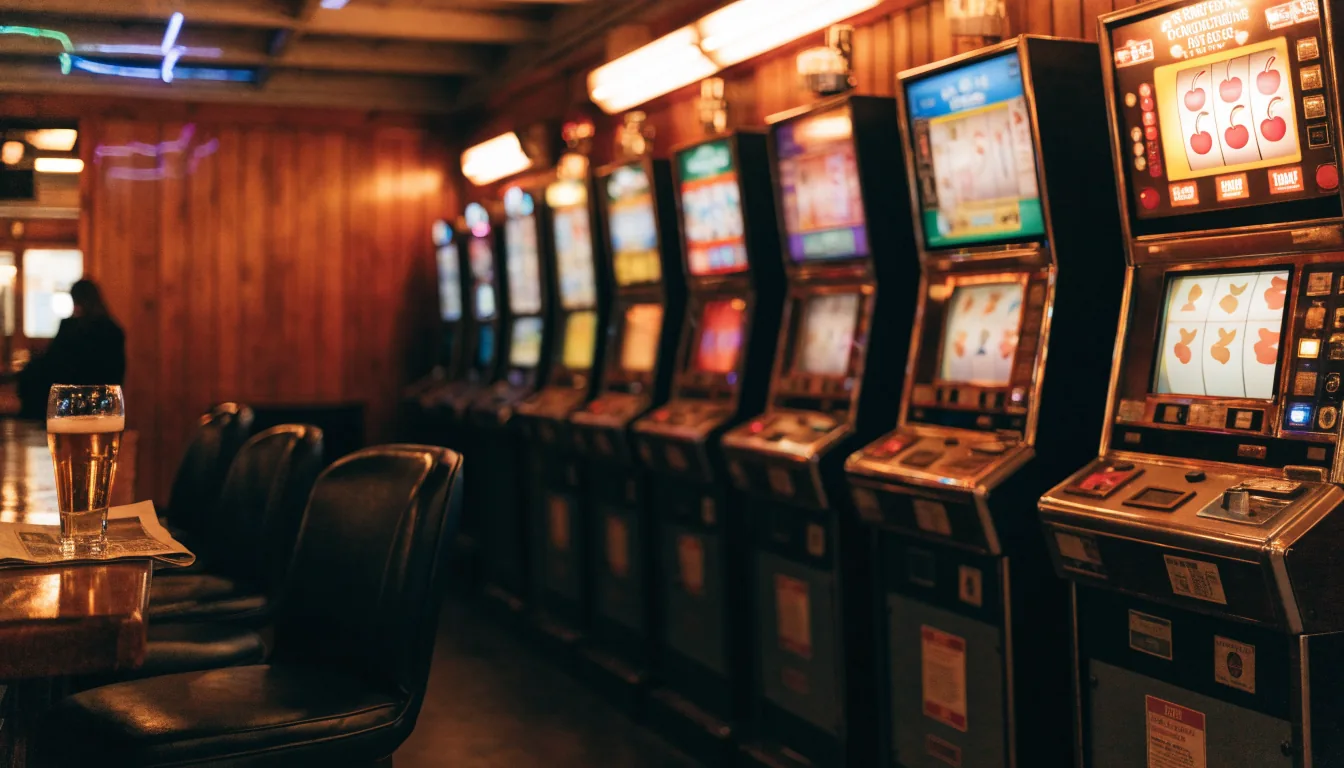
A claim that one pokie is “best” in Tasmania needs a defined basis for comparison. A player might mean a particular style of play, a feature or a machine’s rules, but those are not interchangeable measures. Without a stated criterion and comparable evidence, a ranked list would imply a level of certainty that the available information cannot support.
The same caution applies to broad descriptions of pokies in Tasmania. A location label does not, by itself, identify a particular game or establish which machines are available at a given venue. Search terms that combine a town name with Tasmania can also be ambiguous: the words alone do not establish whether the place is in the state or whether a venue there has pokies. Specific claims require specific, current evidence.
Questions about maximum bets and cash payouts call for different information. A maximum bet concerns the stake permitted under a machine’s rules; a maximum payout concerns the amount a particular game can award under its conditions. Neither can be inferred from a general description of Tasmanian pokies, and the two should not be treated as the same measure. A payout figure, if given, would need to be tied to the relevant game and its rules rather than presented as a statewide characteristic.
Choosing online pokies calls for a careful look at the information available about each operator. This list gives Tasmania readers a concise reference point, including stated licensing details and any other listed features.
Roby Casino
Roby Casino is listed with a Curaçao eGaming license held by Roby Games Ltd.
7Bit Casino
7Bit Casino is listed as operating under a Curaçao license, with Dama N.V. named as its operator.
WinSpirit Casino
WinSpirit Casino is listed with a Curaçao eGaming license, OGL/2024/923/0383, issued through Antillephone N.V. Its stated minimum deposit is A$30.
SkyCrown
SkyCrown is listed with a Tobique Gaming Commission license. Its stated payout times are around 10–15 minutes for crypto and 1–5 days for fiat; the minimum deposit is A$30.
JustCasino
JustCasino is listed with a Curaçao Gaming Control Board license.
Golden Pokies
Golden Pokies is listed with a Curaçao license.
LuckyVibe
LuckyVibe is listed with a Curaçao Gaming Control Board license, OGL/2023/176/0095, associated with Hollycorn N.V.
Thor Casino
Thor Casino is listed with a Curaçao license through Antillephone N.V., with Versus Odds B.V. named. Its stated minimum deposit is EUR 20.
DragonSlots Casino
DragonSlots Casino is listed with a Curaçao Gaming Authority license, with Jumpman Gaming Ltd named.
Vegaz Casino
Vegaz Casino is listed with a Curaçao license, OGL/2024/1335/0780. Its stated minimum deposit is EUR 20.
One point about outcomes is clear: a pokie’s Random Number Generator determines each spin separately. A previous result does not make a particular outcome due on the next spin, and a run of wins or losses does not reveal what the next result will be. This independence also means that short sequences cannot, on their own, establish that a game is consistently favourable or unfavourable.
Consequently, “best pokies in Tasmania” is not a conclusion that follows from a game name, a location or a recent sequence of results. Any comparison needs a defined measure and evidence that applies to the specific games being compared. Where those elements are not established, the careful conclusion is limited: the available description does not justify naming or ranking particular pokies.
A pokie’s title alone does not establish its return percentage. A specialist review reports that some game providers let casinos choose between multiple return-to-player (RTP) settings for the same game. Where that option is available, identical titles can therefore be configured with different stated return percentages at different casinos. The reported possibility is specific: it does not establish that every provider offers this choice, or that every casino uses it.
This distinction matters when comparing pokies associated with Tasmania. A return figure attached to a game in one setting cannot automatically be carried over to another casino, venue or platform. The name and presentation may match while the selected RTP setting does not. Conversely, the existence of configurable settings does not show that two particular locations use different ones. Without information identifying the setting in each case, a comparison of the titles alone cannot settle the question.
The same caution applies to descriptions such as “best paying pokies”. That phrase can suggest a stable ranking, but a game name is not enough to establish how its return is configured in a particular place. A claimed RTP is useful for comparison only when it can be tied to the relevant game and setting. If the setting is not identified, the figure may describe a version offered elsewhere rather than the version under consideration.
RTP is also not a prediction of what an individual session will return. It describes a game-level return measure, not a promise about a particular player’s result. Each spin remains an independent random event determined by a Random Number Generator. A higher stated return setting, where confirmed, does not make a win on the next spin more certain, nor does it establish a short-term outcome.
For people comparing casino pokies, the evidence should therefore be separated into distinct questions: whether a provider makes multiple RTP settings available; which setting applies to the particular version; and whether the figure being quoted is tied to that version. A statement about provider capability answers only the first question. It does not identify the setting selected by a casino or verify the return percentage of a specific machine.
Attention: A pokie's title alone does not establish its return percentage, as some providers allow casinos to choose between multiple RTP settings for the same game.
This is relevant to searches for pokies in Tasmania’s cities as well as to broader comparisons across the state. A game appearing under the same title in two places is not, by itself, proof that its RTP is identical. Nor does a difference in return figures, without a clear link to the applicable settings, establish that one venue has a better-paying version. The defensible conclusion is narrower: some providers allow casinos a choice of RTP settings, so the same pokie may have different return percentages in different casino settings.
Accordingly, any comparison of Tasmania-linked games needs setting-specific evidence rather than an assumption based on a familiar title or a general game description. Where that detail is not available, the return cannot be reliably assigned to a particular version. That leaves no sound basis for ranking named pokies as the best paying in Tasmania: the relevant configuration, not just the game’s identity, would have to be established first.
A venue’s published opening hours and the hours during which its pokies can be used are separate details. A bar, club or other hospitality venue may open for food or drinks while a gaming area remains unavailable, or its operating schedule may differ from the venue’s general hours. A listing that gives only an overall opening time therefore cannot, by itself, establish when pokies are operating.
The distinction matters particularly for searches about early-morning or late-night access. A venue shown as open at a particular time does not necessarily have its gaming area open then. Conversely, a general business listing may omit details about the gaming area altogether. The relevant information is the current schedule for the specific venue and, where stated separately, for its gaming facilities. Any comparison between locations should keep those two schedules distinct rather than treating them as interchangeable.
Opening details can also be time-sensitive. A listing may reflect ordinary hours while special events, public holidays, temporary closures or changes to services affect a particular day. These possibilities do not establish that any particular Tasmanian venue changes its hours; they explain why a general listing is not a reliable substitute for confirmation of the relevant date and facility. Where an opening time is important, the clearest evidence is a current statement from the venue that identifies both the date and the service in question.
This qualification is relevant to searches for pokies open now in Tasmania. “Open” can mean that the premises are admitting customers, that the gaming area is operating, or simply that an online directory has not marked the business as closed. Those meanings are not equivalent. A result may be useful as a starting point for locating a venue, but it should not be read as proof that machines are available at that moment.
The same care applies to requests for venues open early or late. Search wording can point to a desired time, but it does not supply evidence about a venue’s actual schedule. An exact opening time needs to come from a source that is current and specific to the venue, rather than from a broad category, an old directory entry or a general description of the premises. If the gaming area has its own hours, those hours are the pertinent ones.
A venue's general opening hours do not necessarily confirm that its gaming area is open, as the two may operate on different schedules.
A location search may combine several different needs: a venue in a particular town, somewhere close to a central business district, or a place that can be reached from an airport. Each requires a different kind of location information. A suburb or town name may identify the general area, while a street address is needed to distinguish one premises from another. A claim of proximity additionally requires a defined point of comparison and a way to assess the route or distance.
The label “near the airport” is not self-explanatory. It can refer to a short journey, a position in the wider airport district or merely a venue that appears in results associated with the airport. Likewise, “in the CBD” may be used loosely unless the boundary of the central business district is clear. Without those distinctions, two descriptions can sound comparable while referring to very different locations or routes.
For a useful comparison, the venue name and address should be treated as the starting facts, not as evidence of travel time. A route depends on the point from which a journey begins, the destination entrance and the mode of travel. A map pin may mark an approximate position rather than a customer entrance. A straight-line distance does not describe a road journey, and a travel estimate can vary with route and conditions. These are limitations of the measurement, not grounds for assuming that a location is close or convenient.
This is why listings should be read for the details they actually provide. An address can support identifying a premises; it does not establish the hours of its gaming area. A map can help situate an address; it does not establish that the venue is open. A page describing food, accommodation or other services does not necessarily confirm that pokies are operating at the time shown for those services. Each claim needs evidence that matches the claim.
The same approach applies to searches referring to “Crown Tasmania”. A name in a search phrase does not establish that a Tasmanian venue with that name exists, that it has pokies, or that it is open. Venue identity should be confirmed from reliable business information before drawing conclusions about location or facilities. A familiar name, a result from another jurisdiction or an automatically generated map entry should not be treated as proof of a local premises.
No general ranking of Tasmanian locations follows from proximity language alone. A location that is closer to an airport may not be closer to a central district, and a venue in a central area may not have the hours or facilities sought. These are separate attributes. Keeping them separate prevents a broad description such as “nearby” from standing in for an address, an operating schedule or confirmation that pokies are available.
A well-specified opening statement answers a limited question: whether the named premises or facility is stated to operate at a particular time. It does not establish all the conditions of access, the number of machines, the terms of use or the nature of oversight at that venue. Those details require separate evidence. This distinction is important because online listings often compress several aspects of a business into one status label.
For instance, “open” may describe the business as a whole rather than the gaming area. “Hours” may refer to a standard weekly schedule rather than a confirmed schedule for a particular date. A result may also remain visible after its information has changed. None of these limitations proves that a listing is wrong; they define what can responsibly be inferred from it.
There is also a difference between an advertised schedule and actual operation. A published schedule indicates what the venue says its hours are, while confirmation on the day addresses whether those hours apply in the circumstances at that time. The distinction matters most when a journey depends on access being available immediately. A location result alone cannot settle that question, and a business’s general opening status may not resolve it either.
Hours should not be conflated with machine oversight. A venue may be open while responsible gambling arrangements are in place, but the opening listing does not describe those arrangements. Conversely, a statement about a responsible gambling officer does not disclose the public opening schedule. Treating these as independent categories makes the information easier to interpret: location identifies where a premises is, opening information concerns when it operates, and oversight concerns the systems and personnel associated with gambling harm.
A list of venues, even if accurate at the time it is assembled, can become less useful as business details change. Names may be presented differently across directories; addresses may identify a broader complex; and opening hours may not distinguish among the venue’s facilities. A list should therefore not be treated as a complete account of Tasmanian pokies availability unless it clearly identifies the relevant premises and the exact service whose hours are being described.
Oversight information has a different evidential status from location and opening information. A report published by regionriverina.com.au describes a requirement applying from 1 July: venues with more than 20 gaming machines must have a dedicated responsible gambling officer (RGO) on duty while the machines are operating. This is a threshold-based requirement, not a statement that every venue must have an RGO. Its stated application is tied both to the number of machines and to the period in which those machines are operating.
That distinction affects how the requirement should be interpreted. It does not establish that a particular Tasmanian venue has more than 20 machines, nor does it identify which venues meet the threshold. It also does not establish the hours of any venue. The requirement described in the report concerns staffing during machine operation for venues that fall within the stated category. A venue’s general business hours cannot be used to infer when an RGO is on duty, just as the presence of an RGO cannot be used to infer that the venue is open to customers.
Venues with more than 20 gaming machines must have a dedicated responsible gambling officer (RGO) on duty while the machines are operating. This is a threshold-based requirement and does not apply to every venue.
The same report describes a one-month grace period for venues to remove signage and introduce responsible gambling officers. The grace period is a transitional detail associated with the reported changes; it should not be read as a standing period that restarts for each venue or as evidence of a particular venue’s compliance. Nor does a report about a grace period establish whether a specific premises has completed the relevant steps. Venue-level compliance is a separate question from the existence of the reported requirement.
The report also describes a requirement for venues to keep a gambling incident register. The register is intended to record occurrences, including situations in which a patron displays behaviour indicating possible gambling harm. This places the focus on recording incidents rather than on the venue’s location, public schedule or machine return settings. It also does not imply that every instance of concern is identical, or that the existence of a register by itself shows how a venue responds in an individual case.
In this context, a responsible gambling officer and an incident register represent distinct elements of oversight. The officer requirement concerns a designated role at venues that meet the reported machine threshold while their machines are operating. The register concerns documenting relevant occurrences. Neither detail should be substituted for the other: a staffing requirement is not a recordkeeping requirement, and a register is not evidence that a dedicated officer is present at all times.
The reported provisions also do not establish the number of gaming machines at a particular venue. That figure would be needed to determine whether the stated threshold applies. A venue’s size, prominence or general description is not a reliable substitute for a machine count. It follows that a broad claim about oversight across all Tasmanian venues would go beyond what the report establishes. The narrower account is that the report describes specific requirements for a defined class of venues and particular recordkeeping duties.
The physical arrangement around gaming machines, ATMs and EFTPOS terminals is relevant to how venue information is presented. Signage directing patrons to gaming lounges should not be placed within eyeshot of ATMs or EFTPOS terminals. Signage directing patrons to ATMs should not be placed within eyesight of gaming machines. These restrictions concern the placement and direction of signage; they are not evidence about a venue’s opening hours or the availability of its machines.
This matters when evaluating claims about facilities within a premises. A venue description may mention cash access or a gaming area, but that description does not show where signs are positioned or whether their placement complies with the relevant constraint. A photograph may capture only part of a room, and a general description cannot establish what is visible from a particular terminal or machine. Physical layout and signage are matters that require venue-specific observation or documentation.
The distinction also prevents a common overreach: the presence of an ATM or EFTPOS terminal does not establish that a gaming area is open, and the existence of a gaming area does not establish that patrons are directed toward cash facilities. Each is a separate feature. An accurate account of a venue should avoid converting a list of amenities into assumptions about how those amenities are arranged or used.
For Tasmanian locations, the most defensible account separates four questions: where the premises are, when the premises are open, when the gaming area operates, and what oversight provisions apply. A result that answers one should not be treated as answering the others. This is especially important where an entry uses broad language such as “open”, “gaming” or “nearby” without specifying the facility, time or reference point.
An address can be checked against a map to clarify which premises a listing refers to. The map’s role is geographical, not operational: it cannot confirm the venue’s current schedule or the status of its gaming area. A venue’s own schedule may address ordinary opening times, but those details should still be distinguished from any separate hours for pokies. Where a listing gives no such distinction, the safe inference is limited to the claim it actually makes.
Descriptions of airport or CBD access likewise need to remain tied to their stated reference points. “Close to the airport” is not a precise travel measure, and “central” is not necessarily a defined district. A route estimate, if supplied, is dependent on the chosen origin, destination and route. It does not prove that the venue is open when a traveller arrives. For that reason, location and timing should be assessed independently rather than combined into a single impression of convenience.
The word “Tasmania” also covers a range of local settings. A result associated with the state may identify a venue in one town without establishing its relevance to another. A state-wide label is not a substitute for the exact town or address, and a venue’s presence in a statewide directory does not make it a nearby option for every location. The meaning of “local” therefore depends on the particular starting point, rather than on the state name alone.
Machine oversight has similarly limited scope. The reported RGO threshold depends on the number of machines and their operation; the incident-register requirement concerns recording certain occurrences. Neither is a venue directory, an opening-hours database or a confirmation that a given location meets a threshold. Keeping those topics separate allows the oversight information to be reported without turning it into an unsupported claim about individual premises.
Taken together, these distinctions allow a restrained answer to requests for Tasmanian pokies that are open at a particular time. The relevant premises must be identified, the gaming area’s schedule must be distinguished from the venue’s general hours, and location claims must be tied to a clear address or reference point. Oversight should then be described on its own terms: the report from regionriverina.com.au sets out a machine-count threshold for an RGO while machines operate, a one-month transition period for signage and officer arrangements, and incident recording. Those points do not identify a particular venue or establish its current hours.
Interest in online pokies associated with Tasmania needs to be considered separately from questions about physical venues. A ferry journey, a casino name, or a location phrase does not establish that real-money online play is legally offered in the state. The relevant rule is national: the Interactive Gambling Act 2001 prohibits companies from providing real-money online casino games, including pokies, to people in Australia without a domestic licence. No Australian online-casino licences have been issued.
Legal Prohibition
The Interactive Gambling Act 2001 prohibits companies from providing real-money online casino games to people in Australia without a domestic licence, and no such licences have been issued.
That distinction matters when a service appears to accept Australian customers. A site’s availability, branding, or claims about its licence do not make its service lawful for an operator to provide in Australia. There is no Australian-licensed online casino, so an offshore operator cannot be treated as a locally licensed alternative. The legal position concerns the company offering the service, rather than making an individual player criminally liable for playing on an offshore site that accepts them.
Queries about pokies on the Spirit of Tasmania or a casino associated with Tasmania can refer to different things: a physical journey, a venue, or online access. They do not, by themselves, establish that pokies are available on a vessel or that a particular casino operates in Tasmania. Those are questions about real-world services and locations, not evidence that an online casino is authorised to serve Australian customers.
The same caution applies to searches that attach “Tasmania” to a casino name. A familiar name, regional wording, or a page that appears locally targeted is not proof of a domestic online licence. Since no such licences have been issued, a real-money online casino cannot be described as Australian-licensed. Nor does a site’s willingness to accept registrations or deposits change the legal status of the operator’s service.
This distinction avoids conflating online gambling with physical venues. An online page may be accessible from a device in Tasmania even where the operator is offshore and the service is not legally permitted to be supplied to people in Australia. Conversely, a search mentioning an island, ferry, or casino does not verify that an online game is offered there. Availability claims require evidence about the specific service and its setting; a search phrase alone supplies neither.
Phrases promising online pokies without a deposit, or describing play for real money, do not alter the legal framework. A bonus label is not a licence, and an offer does not create consumer protections under Australian online-casino regulation. In this market, the central issue is not whether an offshore site advertises a promotion, but that no domestic online-casino licence exists and operators are prohibited from supplying these real-money games to people in Australia.
Promotional language may also obscure the conditions attached to an offer. Terms can govern eligibility, withdrawal, and the use of credited funds, and their presence does not establish that winnings will be paid. More importantly, an apparent offer should not be taken as evidence that the service is legally authorised in Australia. No offer or bonus is recommended here.
Australian players may encounter offshore sites that accept them, but access should not be mistaken for domestic regulation. The law targets operators, not individual players; that does not make an offshore service locally licensed or provide the protections associated with a domestic online-casino regulator. If an offshore casino refuses to pay winnings, Australian players have no legal recourse in Australia.
Warning: Australian players using offshore sites have no legal recourse in Australia if the operator refuses to pay winnings.
Access can also be disrupted. The fact that a site loads, appears in results, or has previously been reachable does not establish that it will remain accessible. Nor does a site’s own account of its status settle whether it may lawfully provide real-money online pokies to people in Australia. These are separate questions: technical access is not authorisation, and a claim made by an operator is not an Australian licence.
BetStop has a limited scope in this context: it applies to Australian-licensed operators and does not bind offshore sites. As no Australian-licensed online casino exists, it should not be treated as a safeguard that prevents access to, or participation with, offshore casino sites. It cannot supply the protections that are absent from an offshore relationship.
Before any withdrawal from an offshore service, identity and address documents should be verified in line with the operator’s requirements. That practical step does not make the operator licensed, guarantee payment, or provide a route to recover winnings if a dispute arises. The legal and financial exposure remains materially different from dealing with a locally regulated service.
A request for online pokies near Tasmania may describe a desire for local access, but online services do not become local simply because they are reachable from the island or tailored to Australian visitors. The legal status turns on the service being supplied to people in Australia, not on whether its website uses regional language or appears geographically close.
Likewise, a phrase referring to central Tasmania does not identify a lawful online provider. It may be intended to locate a physical venue, which is a separate subject, or it may describe online access. In either case, proximity wording cannot establish licensing, payment security, or an entitlement to winnings. These distinctions are especially important where a service uses local imagery or presents itself as connected to a familiar Australian place.
The available conclusion is narrow but clear: real-money online pokies are not supplied by an Australian-licensed casino, because no such licence exists. Offshore sites may accept Australian players, but acceptance does not make their operators lawful domestic providers, and an Australian player cannot rely on Australian legal recourse if an offshore casino withholds winnings.
PayID is a way to address a bank transfer, not a separate payment network. It uses the New Payments Platform (NPP), which is supported by all major Australian banks and uses end-to-end encryption. A transfer can be directed using an email address, mobile number or Australian Business Number (ABN), rather than entering the recipient’s account details.
That functionality does not establish that a venue’s pokies accept cashless payments. Nor does a PayID option, wherever it is presented, establish that a gambling service is lawful, that a game is fair or that its return settings are disclosed. Payment infrastructure and gambling oversight are separate matters.
Reports from a specialist gambling-payment review have noted that some Australian banks, including major banks, may block PayID transfers to gambling merchants they identify. Such restrictions can change and may depend on the bank or recipient. A transfer method being available in general therefore does not mean a particular gambling-related payment will be processed.
For Tasmania, the term “cashless pokies” can refer to different things: a machine or venue payment arrangement, or a transfer method mentioned in connection with gambling online. Those are not interchangeable. PayID describes how a bank transfer is addressed; it does not by itself describe how a physical pokie is funded or managed.
The distinction matters given the Australian legal position for online gambling. PayID’s presence should not be read as evidence that an online casino has Australian approval. The NPP’s security features concern the transfer system; they do not certify the recipient or the purpose of a payment.
Accordingly, PayID is best understood narrowly as a bank-transfer identifier. Its availability says little about cashless arrangements at Tasmanian venues and nothing, on its own, about a gambling service’s legality or game conditions.
Yes, Australians can legally play on offshore sites that accept them, but companies cannot legally offer real-money online pokies to Australian residents without a domestic licence. No Australian-licensed online casino exists, and players have no legal recourse in Australia if an offshore casino withholds winnings.
There is no Australian-licensed online casino, and Australian players have no legal recourse in Australia if an offshore casino refuses to pay winnings. ACMA blocks access to illegal offshore gambling sites, but that does not provide players with protection or a way to recover unpaid winnings.
You must be at least 18 years old to gamble online in Australia.