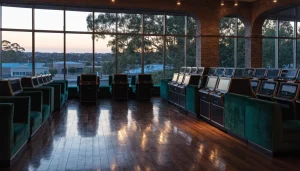
Venue listings may show trading hours without confirming gaming-room availability, so direct checks matter before travelling.

A venue’s advertised opening time and the hours when its pokies are operating are not necessarily the same thing. A venue may be open for food, drinks or other services while its gaming area is unavailable, or the machines may start operating later than the venue itself opens. A listing that says a venue is open therefore does not, by itself, establish that pokies are available at that time.
This distinction matters when checking whether a venue is open early, late or at a particular hour. An online listing may describe the venue’s general trading hours without specifying machine operating periods. Even a current-looking listing can leave that point unclear. Before setting out, the practical step is to check directly with the venue and ask whether its gaming area and pokies will be operating at the intended time. If the visit depends on a particular opening time, the question should be specific rather than simply asking whether the venue is open.
The same care applies to searches for Adelaide pokies that are open now. “Open now” can refer to the whole premises, not necessarily to the machines. A result showing that a venue is trading should not be treated as confirmation that a patron can access its gaming area at that moment. Posted hours, venue listings and general descriptions may not make this distinction explicit. Confirmation of machine availability is the more relevant detail when pokies are the reason for travelling.
Choosing pokies in Adelaide is easier when you can check the available operator information before deciding where to play. This list gives a concise reference to the licensing and payment details provided for each option.
Roby Casino
Roby Casino is listed with a Curacao eGaming license held by Roby Games Ltd.
7Bit Casino
7Bit Casino is licensed in Curacao and operated by Dama N.V.
WinSpirit Casino
WinSpirit Casino holds a Curacao eGaming license, OGL/2024/923/0383, issued through Antillephone N.V. Its stated minimum deposit is A$30.
SkyCrown
SkyCrown is licensed by the Tobique Gaming Commission. Its stated payout times are around 10–15 minutes for crypto and 1–5 days for fiat; the minimum deposit is A$30.
JustCasino
JustCasino is listed as licensed by the Curacao Gaming Control Board.
Golden Pokies
Golden Pokies is listed with a Curacao license.
LuckyVibe
LuckyVibe holds a Curacao Gaming Control Board license, OGL/2023/176/0095, under Hollycorn N.V.
Thor Casino
Thor Casino is licensed in Curacao through Antillephone N.V. (Versus Odds B.V.). Its stated minimum deposit is EUR 20.
DragonSlots Casino
DragonSlots Casino is listed with a Curacao Gaming Authority license held by Jumpman Gaming Ltd.
Vegaz Casino
Vegaz Casino is listed with Curacao license OGL/2024/1335/0780. Its stated minimum deposit is EUR 20.
Hours can also differ across days or change over time. A schedule found in an old listing may not reflect the venue’s current arrangements, and a broad description such as “open late” does not identify when machine operation ends. Where the timing is important, checking the current schedule with the venue is more dependable than inferring machine hours from general opening information. This is especially relevant for early-morning visits, when a venue’s doors may be open for one purpose but its gaming facilities may not yet be operating.
There is a regulatory detail that concerns staffing, not a timetable. A report published by regionriverina.com.au said that, from 1 July, venues with more than 20 gaming machines are required to have a dedicated responsible gambling officer (RGO) present while those machines are in operation. That requirement links officer coverage to the period of machine operation at qualifying venues. It does not establish when any particular venue opens its gaming area, nor does it mean that the general venue opening time is the same as the machines’ operating time.
For that reason, the RGO requirement is not a substitute for checking hours. It describes a duty attached to machine operation at venues above the stated machine threshold; it is not an announcement that machines operate continuously or from the moment the premises open. The presence of the required officer, where the rule applies, indicates a staffing obligation during operating periods rather than a public schedule.
When checking a venue, the useful distinction is between three separate details: the premises’ opening hours, the availability of the gaming area, and the period when its pokies are operating. A listing may provide only the first. If the information available does not separate them, a direct enquiry can clarify whether the machines will be operating at the proposed arrival time. This avoids treating general trading hours as a promise of access to the gaming facilities.
The wording of an enquiry can be straightforward: whether the gaming area is open at the planned time, and whether pokies will be operating then. If the visit is close to a changeover in the venue’s schedule, confirming the day as well as the time can reduce ambiguity. No particular Adelaide venue’s opening or machine schedule should be assumed from a general description alone.
A search for a venue open now can therefore identify a possible place to investigate, but it cannot settle the machine-hours question unless those hours are expressly stated and current. The distinction is practical rather than technical: the premises may be open, while the activity sought is not available. Checking the specific operating period before travelling is the clearest way to avoid relying on an opening time that refers only to the venue as a whole.
Claims about the best-paying pokies in Adelaide depend on more than a game’s title or appearance. Two features matter when assessing what can be said about performance: the randomness of individual spins and the possibility that the same game is configured with different return-to-player (RTP) settings at different casinos. Neither feature makes the outcome of a particular session predictable.
A pokie uses a Random Number Generator to determine each spin. The result of one spin does not determine the next: each is an independent event. A run of wins therefore does not establish that another win is due, and a sequence of losses does not make a win more likely on the next spin. The same reasoning applies in reverse; a single win does not show that the game has entered a more favourable phase. Recent results are not evidence of what the next result will be.
This independence places a limit on what can be inferred from short play. A player may observe a particular sequence, but that sequence does not reveal a dependable pattern for predicting future spins. Nor does an outcome in one session establish that a game will perform similarly in another. Statements that a game is “due” to pay, or that a recent win streak signals continued favourable results, do not follow from the independence of spins.
RTP is relevant, but it must be interpreted separately from the result of any individual spin. A specialist review reports that some game providers let casinos choose among multiple RTP settings for a given pokie. On that account, the same game may have different return percentages at different casinos. A game’s name alone, therefore, does not establish which setting applies in a particular location. The distinction is between the identity of the game and the configuration under which it is offered.
That distinction also limits comparisons based only on a game title. If the configuration differs, treating every version as identical can obscure a material difference in the stated RTP. Even where a return figure is provided, it is not a promise about what an individual session will yield. The independence of spins means that the figure cannot identify the outcome of the next play or guarantee a particular result over a short period.
Accordingly, phrases such as “best-paying” need a clear basis. A ranking built from game names alone would not account for differing RTP settings, while an RTP figure without confirmation of the relevant configuration may not describe the version being played. A comparison is more informative when it identifies the game and the applicable setting, rather than relying on popularity, recent stories or impressions from a small number of outcomes.
The same care applies to reports of wins. A large payout demonstrates that a particular outcome occurred; it does not, by itself, establish the game’s usual performance or show that another player should expect a comparable result. Likewise, a player’s experience of losses cannot determine the setting used by a casino or predict the game’s next spin. Individual outcomes and configuration information answer different questions.
For Adelaide players considering pokies in a casino or club, the location does not change these game-level limits. The relevant distinction remains between a spin’s unpredictable result and the return setting associated with the game version. A venue’s presence in the city, or a game’s reputation, cannot by itself resolve either point. Performance claims are therefore strongest when they specify the particular configuration being discussed and avoid treating isolated results as evidence of a predictable pattern.
This is a narrower conclusion than a promise to identify a winning choice. The mechanics support a clear account of uncertainty: spins are independent, and RTP settings may vary for the same game across casinos. They do not support treating previous outcomes as a guide to the next one, or assuming that a familiar title has the same return setting wherever it appears.
References to Adelaide Airport, the city centre or North Adelaide describe different location interests, but the wording alone does not identify a particular pokie venue. “At the airport” can suggest a site within an airport precinct, while “near the airport” can mean a wider surrounding area. Likewise, “near the CBD” does not specify a distance or establish that a venue is inside the central business district. These phrases should not be treated as interchangeable descriptions of one place.
The same distinction applies to searches for pokies near Adelaide. A general city reference gives less geographic detail than a suburb or landmark, but even a more specific place name does not establish how close a venue is. A search framed around “near me” depends on the location being used at that moment; it does not, by itself, define a radius or confirm that a result is within walking distance. The location wording is a starting point for identifying an area of interest, not a precise description of a venue’s position.
Airport-related wording can also carry more than one meaning. It might refer to the terminal, airport grounds, surrounding roads or nearby suburbs. Those are materially different settings, and a result labelled “Adelaide Airport” may not mean that pokies are located inside the airport itself. Similarly, a reference to North Adelaide points to a distinct part of the city rather than serving as a general synonym for central Adelaide. Location labels need to be read in their ordinary geographic sense, without inferring a specific venue or travel distance from the wording alone.
For practical comparisons, the useful distinction is between a venue’s stated address and a broad location description. An address can be assessed against the intended destination; a phrase such as “near the airport” cannot establish the route, travel time or exact separation. No single interpretation of “near” applies across every search, because the term has no fixed distance built into it. The same applies to “CBD”: it can be used loosely in everyday descriptions, while a venue’s address is the more exact geographic reference.
The relevant entry requirement does not change with location. In Australia, the legal age for gambling is 18, including for online pokies. Being at an airport, in the CBD or in North Adelaide does not create a different age threshold. Location wording is therefore separate from eligibility: it describes where someone is looking, not who may legally gamble.
A careful reading of airport and inner-city descriptions keeps three ideas distinct: the area named, the precise position of any venue, and the legal age requirement. A broad place label should not be taken as confirmation of an on-site location, a particular distance or a specific travel option. For searches focused on Adelaide Airport, central Adelaide or North Adelaide, geographic wording alone cannot settle those details.
In Australia, the legal age for gambling, including online pokies, is 18 regardless of the specific location such as the CBD or airport.
Assessing an Adelaide pokie venue involves more than considering its machines or location. Venue-level safeguards also matter: requirements for responsible gambling officers, incident records and signage describe how gambling-related risks are to be handled. These measures do not establish that one venue is better than another, but they provide a basis for understanding its oversight obligations.
A report by regionriverina.com.au described a transition period for venues introducing responsible gambling officers and removing signage. It said venues would have a one-month grace period for those changes. That period is a reported transition arrangement, not a general measure of how quickly every venue implements safeguards. The report’s account does not, by itself, establish the present status of any particular Adelaide venue.
A responsible gambling officer has a defined role in the venue’s response to signs of gambling harm. The relevant requirement applies to venues with more than 20 gaming machines: an officer must be on duty while those machines are operating. The presence of that role is a staffing safeguard; it should not be taken as proof that harm cannot occur or that every concern will be resolved in a particular way.
Record-keeping is another part of oversight. Venues are required to keep a gambling incident register, with entries covering occurrences such as a patron displaying behaviour that suggests they may be at risk of, or affected by, gambling harm. The register makes incidents part of a documented process rather than leaving them solely as informal observations. Its purpose is to record relevant events; the existence of a register does not reveal what has been recorded at a specific venue.
Signage also forms part of the venue environment. Signs directing patrons to gaming lounges must be removed when they are within sight of ATMs or EFTPOS terminals. Signs directing patrons to ATMs must be removed when they are within sight of gaming machines. These restrictions concern the placement and direction of signs, not a venue’s overall quality or the conduct of every patron.
For anyone comparing pokie venues in Adelaide, these obligations offer a more concrete point of reference than broad labels such as “best”. They identify processes and controls expected at venue level, but they do not supply a comparative assessment of individual venues. Nor does a policy description confirm that a particular site has completed a transition or maintained its records appropriately.
The distinction is important: a responsible gambling officer and an incident register are safeguards, not measures of machine performance. Likewise, signage controls address the setting in which gambling takes place; they do not determine whether a venue is suitable for a particular person. Venue oversight is therefore best understood through its specific duties, rather than treated as a ranking or endorsement.
Payment options describe how money may move; they do not establish that an online gambling service is lawful, fair or transparent. A PayID logo, a card option or a low deposit threshold cannot verify any of those things. This distinction matters when comparing payment claims associated with Adelaide pokies, including offers framed around real-money play or a no-deposit bonus.
Attention: Some Australian banks may block PayID transfers to gambling merchants, and card issuers may process such payments as cash advances with associated fees and interest.
PayID is linked to a bank account before it can be used for a transfer. It is not a separate source of funds: the payment still depends on the account and the bank’s handling of the transaction. A specialist review has reported that some Australian banks, including members of the Big Four, have at times blocked PayID transfers to gambling merchants they recognise. That is a reported possibility, not a guarantee that a particular transfer will be accepted or declined. Payment availability can depend on the bank and the transaction.
Card deposits have a different potential cost. A specialist review has noted that a bank or card issuer may process a gambling payment as a cash advance rather than an ordinary purchase. If that classification applies, a fee of 3–5% and interest from the transaction date may follow. The treatment is determined by the relevant issuer, so a card appearing as an option does not disclose the cost or processing category in advance. Credit cards are not a dependable way to infer what a service permits, and payment claims should not be treated as an endorsement.
An apparent deposit method also says little about the conditions attached to a balance. A payment can be accepted while a later withdrawal remains subject to account checks or other terms. Deposit instructions and withdrawal rules are separate matters; the former do not establish how promptly or reliably the latter will be handled.
Account verification is a practical issue before any first withdrawal. Specialist reviews report that online operators may ask for identity documents and proof of address at that stage, with some also requesting a photograph of the account holder holding identification. The required documents and review process can vary. Where a withdrawal depends on verification, incomplete or inconsistent documents may delay the process. Identity and address proof should therefore be verified as requirements before a first withdrawal is attempted, rather than assumed to be unnecessary because an account accepted a deposit.
Searches for online pokies in Adelaide may combine payment questions with claims about bonuses or low-cost entry. Those claims do not remove the need to read payment and withdrawal conditions closely, and a deposit option cannot establish whether an offer is available on the stated terms. For PayID, the account link is essential; for cards, issuer treatment can affect cost; for withdrawals, identity and address checks may still apply. These are distinct parts of a transaction, not evidence that an online service is authorised or that funds will be returned.
The legal distinction is between the service provider and the person using the service. Under the Interactive Gambling Act 2001, companies cannot lawfully provide real-money online pokies to people in Australia without a domestic licence. No such licences have been issued, so there is no Australian-licensed online casino. This applies whether the service is described as an Adelaide casino online or is accessed from elsewhere in the country: a local-sounding label does not change the operator’s obligations.
Legal Risk
Offering real-money online pokies to people in Australia without a domestic licence is prohibited, and players have no legal recourse in Australia if an offshore operator refuses to pay winnings.
The prohibition is directed at operators, not individual players. Australians are not subject to a player offence under this law simply for playing on an offshore site that accepts them. That distinction does not make the service lawful for the operator, establish that it is available in practice, or provide the protections associated with a domestic licensing system. The Australian Communications and Media Authority (ACMA) enforces the Act and blocks access to illegal offshore gambling sites; internet service providers must comply with its blocklist.
The practical consequence is significant if an offshore operator refuses to pay winnings. Australian players have no legal recourse in Australia to recover those funds. The fact that an overseas service accepts a person or displays account balances does not create a domestic licensing relationship or a local route for resolving a payment dispute. Searches for online pokies near Adelaide, or for higher-stake play, do not alter that position. Nor does an operator’s use of Australian payment options establish that it is licensed, fair or subject to Australian casino oversight.
BetStop has a limited scope in this context. It applies to Australian-licensed operators and does not bind offshore sites. Because no Australian-licensed online casino exists, BetStop should not be understood as a control that prevents access to, or participation with, offshore online casino services. Its limits matter when considering what protections are available; it does not change the legal obligations imposed on operators by the Interactive Gambling Act.
This position is distinct from the regulation of physical venues. A person searching for pokies in Adelaide, whether in the city or elsewhere, may be referring to land-based gaming machines rather than remote online casino services. The rules for online operators should not be inferred from the existence of physical gambling venues, and a search for an Adelaide-based online service does not establish that such a service is locally licensed.
Accordingly, the central legal facts are narrow but important: offering real-money online pokies to people in Australia is prohibited for operators without a domestic licence; no Australian online casino holds one; and the law does not target players in the same way. That distinction does not supply Australian legal recourse when an offshore casino withholds winnings.
A venue’s advertised opening hours do not necessarily show when its pokies are operating. A bar, dining area or other part of a venue may be open while the gaming area is unavailable; conversely, a listing that says a venue is open does not establish that its machines are running. The distinction matters when assessing claims of round-the-clock availability: “open” can describe the premises, not the hours of play.
No general claim about Adelaide pokies opening hours can substitute for the operating schedule of a particular venue. Hours may differ between premises and may change, so a general description of a venue’s trading day is not enough to confirm that pokies are available at a particular time. A reference to 24-hour opening, where one appears, should therefore not be treated on its own as confirmation of continuous machine operation.
There is also a staffing condition linked specifically to machine operation. A report by regionriverina.com.au describes a requirement taking effect from 1 July for venues with more than 20 gaming machines to have a dedicated responsible gambling officer (RGO) on duty while those machines are operating. The requirement concerns coverage during operating periods, rather than simply the hours when a venue’s doors are open. It does not establish that a venue operates continuously, nor does it confirm the current hours of any Adelaide premises.
Venues with more than 20 gaming machines must have a dedicated responsible gambling officer (RGO) present during machine operation. Additionally, venues are required to maintain a gambling incident register to document patrons at risk of harm.
That distinction helps make sense of what an hours listing can and cannot establish. A venue’s published schedule may describe general access, while machine operation is a separate matter. Neither a late closing time nor a statement that a venue is open now, by itself, proves that pokies are available then. The operating period is the relevant one for the RGO duty described in the report.
The same report says venues will be required to maintain a gambling incident register. It is intended to record occurrences, including behaviour that indicates a patron may be at risk of gambling harm or already affected by it. This is an operational safeguard, not a timetable or an assurance that machines are available throughout the venue’s advertised hours.
In practical terms, opening information and safeguards answer different questions. Venue hours describe when the premises are open; the machine schedule determines when pokies operate; and the reported RGO requirement applies while machines are running at venues above the stated machine threshold. The incident register concerns the recording of relevant occurrences. These obligations should not be read as evidence that any particular Adelaide venue is open all night or offers continuous access to pokies.
A reference to Crown in connection with Adelaide does not, by itself, identify a Crown-branded venue or establish which pokies are installed there. Venue names, machine inventories and payout terms are separate claims; one cannot be inferred from another. Accordingly, a description of a “Crown” pokies room in Adelaide should not be treated as confirmation that such a room exists or that particular machines are available there.
The same distinction applies to requests for the best pokies room in Adelaide. A venue’s branding would not establish that its machines offer better returns, and a room’s reputation would not show how a particular game is configured. No ranking of Crown-associated rooms or machines can be supported on the basis of the name alone.
There is also a technical reason not to infer performance from a game title. A specialist review reports that some providers allow casinos to choose among different return-to-player settings for the same pokie. If that option is used, identical games could have different RTP values at different casinos. This is a general caveat about game configuration, not evidence about Crown, an Adelaide venue or any specific machine. A game’s title therefore cannot establish the setting in place at a particular location.
Claims about a maximum cash payout require their own basis. The phrase may refer to a game’s stated prize limit, a venue’s payment procedure or a different condition altogether. Those are not interchangeable. A figure attached to one interpretation would not establish the maximum payable in another, and the Crown name does not supply the missing terms.
For the same reason, statements about “pokies at Crown” should be precise about what they describe. A branded venue, a game’s theoretical return and a payout condition are distinct matters. Evidence for one would not automatically confirm the others.
A game's title alone cannot establish its return-to-player (RTP) setting at a specific venue, as providers may allow casinos to choose between different configuration options.
Searches for pokies in Adelaide’s central business district or at local clubs do not, by themselves, establish that a particular venue offers a specific limit-setting feature. Deposit limits, loss limits, session time limits and self-exclusion are standard responsible-gambling tools, but their presence as general tools should not be mistaken for confirmation of the arrangements at any individual venue.
Each measure addresses a different aspect of play. A deposit limit restricts the amount put into play over a defined period; a loss limit sets a boundary on losses; and a session time limit places a constraint on time spent playing. Self-exclusion is distinct: it is a way to restrict access to gambling rather than simply set a financial or time boundary. These tools are not interchangeable, and one does not establish that the others are available or active.
For searches about Adelaide CBD pokies or club venues, the useful distinction is between the general availability of these safeguards and venue-specific information. The fact that such tools are standard does not show which limits a particular venue offers, how a limit is set, when it takes effect, or how a self-exclusion request is administered. Those details should not be inferred from a venue’s location, its club status or a broad description of its facilities.
Limits can also be understood as practical boundaries rather than indicators of likely outcomes. A deposit cap does not predict what a session will cost, and a time limit does not change the random nature of individual spins. Self-exclusion serves a different purpose from both: it is relevant when restricting access is the intended safeguard, rather than managing the size or duration of play.
Accordingly, a comparison of central Adelaide venues or clubs cannot be reduced to a claim that one has “better” pokies on the basis of general limit tools. The meaningful point is whether the relevant safeguard is available and how it operates at the specific venue. Without venue-specific details, claims about particular CBD locations would go beyond what these general measures establish. The same caution applies to self-exclusion in Adelaide: the tool is part of the wider set of responsible-gambling measures, but its practical scope should not be assumed to be identical across venues.
PayID is sometimes mistaken for a general cashless payment feature, but it describes a way to address a bank transfer. It lets a transfer be directed using an email address, mobile number or Australian Business Number (ABN), rather than relying on account details alone. PayID operates as an alias layer within the New Payments Platform (NPP), Australia’s bank-transfer network.
The NPP is supported by all major banks and protects transfers with end-to-end encryption. Those characteristics describe the payment infrastructure; they do not establish how a particular pokie accepts funds. A bank-transfer alias is not, by itself, evidence of a contactless terminal, a cashless gaming system or a venue’s payment arrangements. Nor does PayID support indicate that a gambling service is licensed or that its games are fair.
The distinction matters when considering claims about cashless pokies in Adelaide. The phrase can refer to several different things: a venue’s broader payment facilities, a system for loading funds onto a gaming card, or simply an electronic transfer method. These are not interchangeable. Without a specific, substantiated description of the arrangement, PayID should be understood only as a transfer identifier used within the NPP, not as proof that Adelaide pokies offer a cashless playing function.
Newcastle and Adelaide are separate place names. Combining them in a description does not identify an Adelaide venue, establish a connection between the cities, or demonstrate that a particular pokie has cashless functionality. Geographic wording alone cannot support those conclusions.
Accordingly, PayID’s role is best described narrowly: it can identify the destination for an NPP transfer through an alias. Its security and bank support are properties of the payment network, not a certification of any gambling product or venue. Claims about machine-level cashless functions require evidence about the specific system being described.
Yes, Australians can legally play on offshore sites that accept them, because the law targets operators rather than individual players. However, no Australian-licensed online casino exists, and players have no legal recourse in Australia if an offshore casino withholds winnings.
You must be at least 18 years old to gamble online in Australia.
Yes. Some providers let casinos choose from multiple RTP settings for the same game, so its return percentage can vary between casinos.
Yes. PayID is treated like any other qualifying deposit method at the recommended sites.